Projects
Jump to: Personal work · Professional work · Earlier work
Personal work
Own projects with public code: networked VR, gesture-driven VR, Unreal / C++.
VR Survival Zombies
2-player co-op VR shooter for Meta Quest · Personal project, 2025–2026 · Available on the Meta Quest Store · In review on SideQuest
My contribution
Sole developer: architecture, netcode, VR interactions, zombie AI, VFX, tests and Quest profiling.
- Networked weapon pickup, two-handed handling and reloading on AutoHand physics hands, with state authority transferred between players in Photon Fusion 2 Shared Mode.
- Throwable grenades with physics synchronized across clients.
- Wave-based zombie AI on NavMesh, simulated by the session master and replicated to the second player.
- Networked full-body IK avatars: head and hand targets are replicated and each client solves the IK locally, instead of sending bone data.
- Unit tests with the Unity Test Framework for the scalability-sensitive systems; playtest sessions to find and fix gameplay and network bugs.
- Custom VFX built within the Quest frame budget; profiled on device to hold the target framerate.
Stack
- Unity 6
- C#
- Photon Fusion 2 (Shared Mode)
- AutoHand
- Meta Quest
- OpenXR
- NavMesh
- Unity Test Framework
- Git
Main technical challenge
Keeping physics-driven interactions consistent for both players. A grenade thrown by one player has to land in the same place for the other, and a rifle grabbed from a teammate has to change authority without snapping. I documented each networked system in the README: when to use replicated state vs. RPCs, how authority transfer works in Shared Mode, why there is no lag compensation in that mode, and the interpolation asymmetry between the owning client and the proxy, measured under simulated latency.
Links
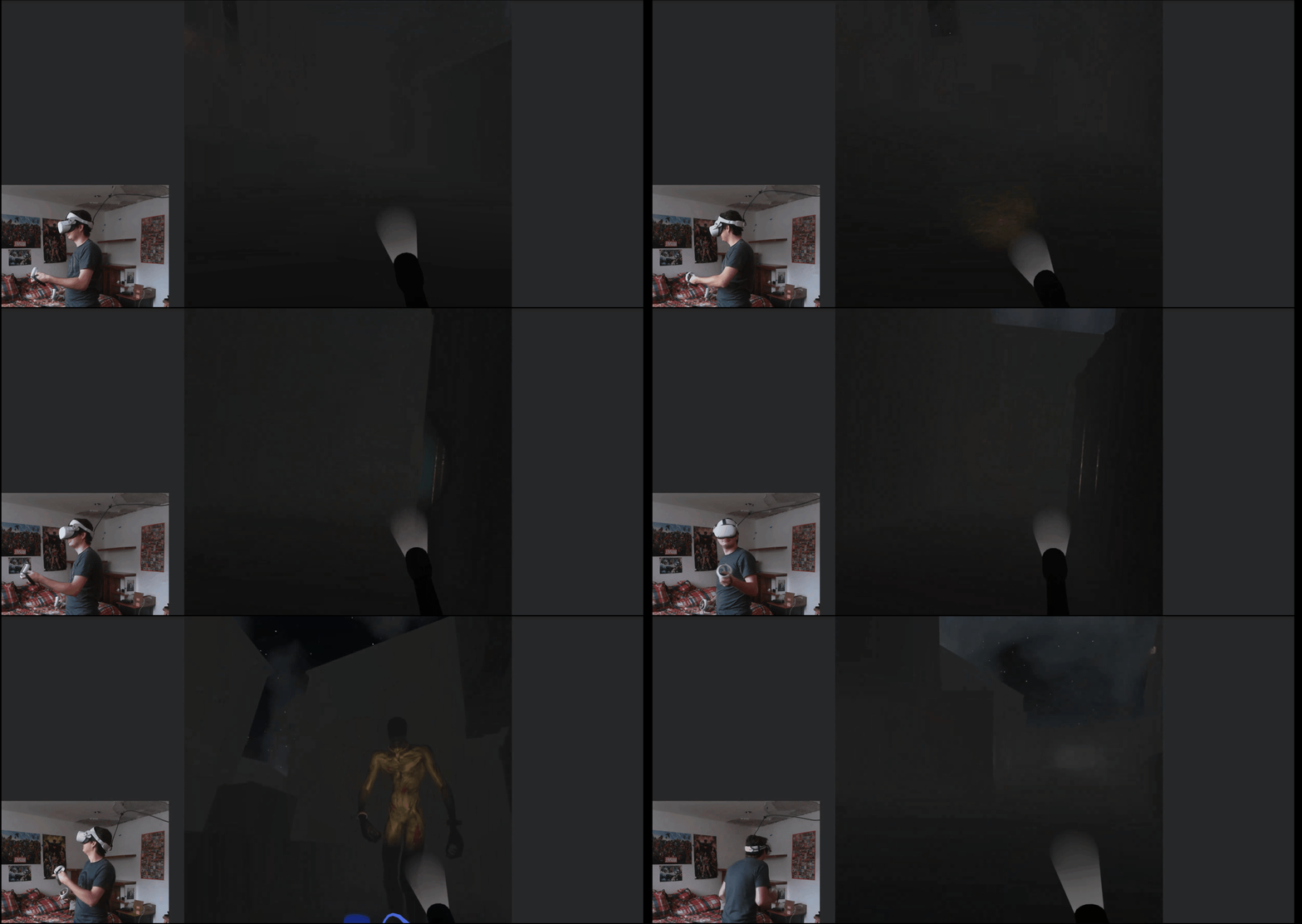
RUN — VR Horror Game
Unity 6 + XR Interaction Toolkit 3 · Team of 2 · Published on itch.io
My contribution
Gameplay programming and the 2025 engine migration. Made with Guillermo Vega, who recorded the gameplay footage.
- Gesture-driven mechanics: integrated the $P point-cloud recognizer to classify in-air hand strokes as input (gesture locomotion, flashlight recharge), with confidence thresholds and runtime template training.
- Physics-based climbing driven by hand velocity, built on XRI 3's interactor handedness model, that cleanly takes over from locomotion.
- Migrated the project from deprecated XRController APIs to Unity 6, XRI 3.3 and OpenXR.
- NavMesh enemy AI and a resource-driven flashlight loop.
Stack
- Unity 6
- C#
- XR Interaction Toolkit 3
- OpenXR
- $P recognizer
- NavMesh
Main technical challenge
Turning noisy controller trajectories into reliable gameplay input. A stroke has to be recognized as "run" quickly enough to feel responsive, but not so loosely that reaching for the flashlight triggers it. The answer was a template-based classifier with a tuned confidence threshold and the ability to record new templates at runtime.
Links
Unreal Engine 5 / C++
Second engine.
First-Person Shooter
Unreal Championship 2023 · C++
- Cellular automaton grid in C++: RGB tiles that change over time control which enemies are vulnerable; players must stand on the matching tile to deal damage.
- Weapon, enemy and pickup systems in C++ with Blueprints for tuning.
3D Platformer
Tec de Monterrey UE5 diploma · Blueprints
- Character controller, moving platforms and collectibles in Blueprints.
- Niagara VFX, Sequencer cinematics, Chaos destruction, lighting and world building.
Professional work
Shipped work for clients and employers.
VR Anesthesiology Simulation
Virtual Medical Learning · Unity VR Developer · June 2024 – June 2025 · Meta Quest 3
My contribution
Took features from concept through implementation, on-device testing and release, working directly with medical advisors to translate clinical requirements into VR interactions.
- Spatial interaction systems: constrained free-hand ultrasound probe movement to anatomical splines via vector projection, driving position-indexed ultrasound imagery that stayed in sync with the probe.
- Instrument handling, controlled strokes and haptic feedback built on Unity's New Input System; Observer pattern, interfaces and event-driven architecture to decouple systems.
- Integrated and configured AutoHand 4, Quest Machine, Dialogue System and Odin Inspector to speed up the pipeline.
- Profiled and optimized on Quest 3 to hold the target framerate.
- Presented the simulation to medical audiences and turned their feedback into iterations.
Stack
- Unity
- C#
- Meta Quest 3
- New Input System
- AutoHand 4
- Quest Machine
- Dialogue System
- Odin Inspector
- Haptics
- Unity Profiler
Main technical challenge
The ultrasound transducer. Physicians move the probe freely, but the image shown has to correspond to a real anatomical position. I projected the hand position onto a spline that follows the anatomy, used the resulting parameter to index the imagery, and kept the probe visually attached to the body without fighting the user's hand.
Links
Showcased at an international anesthesiology congress and used by practicing physicians. The application is proprietary to VML; happy to walk through the architecture in a conversation.
Educational Unity WebGL games
ARI Group · Lead Game Developer, team of 3 · September 2024 – present
My contribution
- Lead a team of 3 designers using Agile with Planner for sprints: architecture, task assignment, code reviews, coding standards and mentoring.
- Ship Unity WebGL educational titles to production on a monthly cadence, architected with SOLID principles and reusable design patterns across the portfolio.
- Built reusable gameplay systems: drag-and-drop frameworks, audio-driven selection, platforming physics and state-managed gameplay loops.
- Own the WebGL build pipeline and deployment, and maintain the shipped portfolio: bug fixing, new mechanics and refactors.
Stack
- Unity
- C#
- WebGL build pipeline
- Agile / Planner
- Git
- Code review
Main technical challenge
Shipping on a fixed monthly cadence with a small team. The answer was a shared codebase of reusable systems and clear coding standards, so each new title reuses more than it rewrites.
Interactive museum exhibits and AR
Papalote Museo del Niño, Mexico City · Developer Intern · January – July 2024
My contribution
- Architected from scratch "El universo dentro de mí", an interactive drag-and-drop exhibit with video synchronization and hardware integration, deployed in the museum.
- Took ownership of an existing AR educational game about human body systems, refactored it, optimized it and shipped it.
- Set up the GitLab CI/CD pipeline and supervised one developer: code reviews and milestone coordination.
Stack
- Unity
- C#
- AR Foundation
- GitLab CI/CD
Main technical challenge
Content that has to land correctly in a real environment for visitors who will never troubleshoot it: anchoring and aligning AR content to physical surfaces in a public installation, and keeping a video-synced exhibit running all day without supervision.
Earlier work
Academic projects, game jams and arcade games. Most are playable in the browser on itch.io.
Frequency Based FPS · thesis, Unity
A Fourier transform extracts frequency bands from any song the player uploads and drives the gameplay: low frequencies move the platforms, mid frequencies set enemy spawn rate, high frequencies change the environment. Grappling hook, NavMesh enemies and boss state machines. Play on itch.io. Next step: porting the enemy simulation to DOTS to measure the gain.
Game jams and arcade games
Not on itch.io: a tower defense with custom steering behaviors, decision trees and A* (Unity), and a Space Invaders clone (Processing).